Insights · Article
Who actually owns Amazon in your company?
7 October 2026
Below here find a podcast version of the feature…
7 Oct 2026 · Engblad, PhD for ecoming.dk
Long read · ecoming Insights · about 30 minutes
The fee is not the problem. The organisation is.
Every Amazon conversation in a boardroom ends up in the same place: the fees. Run FBA, add advertising, and roughly half of gross sales flows back to Amazon. That number is real, and it is worth watching.
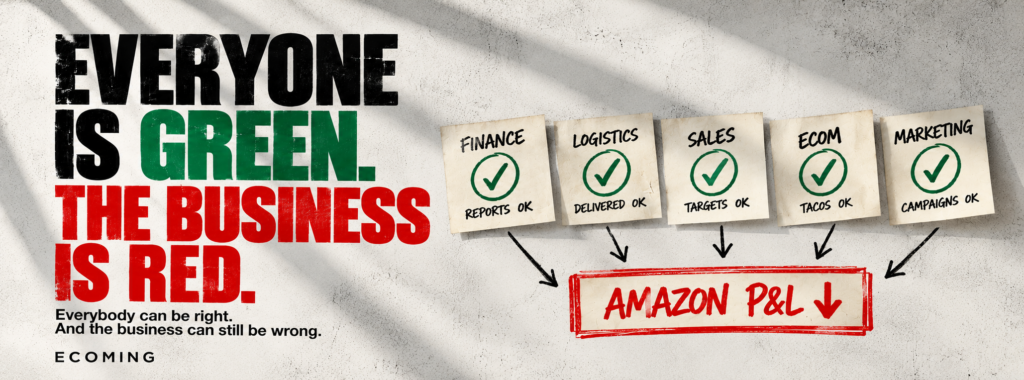
But it is rarely the reason a brand earns too little on Amazon. Most of the margin we see disappear never shows up as a fee. It leaks out between departments. Finance pulls reports it does not fully understand. Logistics never checks what is actually in Amazon’s warehouses. The ecom team is measured on TACOS and nothing else. The sales director holds the P&L for a channel he has never been trained to read.
And it is worth asking who is having that conversation. In many brands, the boardroom is the place with the least hands-on knowledge of digital business. Board members and executives built their careers in retail, wholesale and brand building. Few have ever opened Seller Central, read a settlement report or watched a listing lose its ranking after a stockout. That is no criticism of their experience. It is simply a different business, and the people deciding Amazon’s future are often the ones furthest from how it works.
Nobody in that picture is lazy or incompetent. They are set up to fail. And in many companies there is a quieter problem underneath: some departments simply do not like Amazon. They see it as a necessary evil, a discount channel, someone else’s problem.
This long read is about that. Why good companies get it wrong. What one stockout really costs. Who should own what, who should teach whom, and how to organise. And a practical path to fix it over twelve months. At the end you will find a checklist of hard questions and an estimate of what this costs a typical brand each year.
Four departments, four versions of the truth
In most brands we meet, Amazon is split across four functions. Each one sees a slice. Nobody sees the whole.
Finance pulls reports it does not understand. Amazon’s settlement reports are not a P&L. They mix sales, refunds, reimbursements, advertising, storage, inbound fees, VAT and currency into one stream, often across five or more marketplaces. Finance books the payout, not the economics. Fees land in the wrong cost lines, ads are lumped with marketing, and reimbursements disappear into “other income”. The board then sees a channel that looks worse, or better, than it is.
Logistics is never enrolled. The warehouse team ships pallets to an inbound plan and moves on. Nobody checks that what was sent is what Amazon received. Nobody reconciles lost, damaged or stranded units. Nobody owns the replenishment curve across Germany, France, Italy, Spain and the UK. Stock on Amazon is treated as “sold” the moment it leaves the building.
Ecom is measured only on TACOS. TACOS is a useful ratio. As a single target it is dangerous. The easiest way to lower it is to cut advertising on new products, stop defending your brand terms, and let a competitor take the top of the page. TACOS goes down. So does the business.
The sales director holds the P&L. Often a strong retail person, trained on buyers, listing fees and annual negotiations. On Amazon there is no buyer to negotiate with. The levers are price, availability, content, reviews and advertising, and they move daily. Holding the P&L without the tools or the training to read it is not ownership. It is exposure.
Put those four together and you get a familiar pattern: every department is green on its own KPI, and the channel still loses money.
Why good companies get it wrong
The brands we meet are not badly run. Most of them are excellent at what they built their name on: product, retail relationships, brand. That is exactly why Amazon lands in the wrong place. Five patterns repeat.
1. Amazon arrived through the back door. In many brands, Amazon did not start as a strategy. It started as a problem: grey sellers, a distributor listing the range at the wrong price, a retailer complaining. Someone was asked to “sort out Amazon”. That person, often junior, is still the owner ten years later, and the channel is still treated as a clean-up job rather than a business.
2. The organisation was built for wholesale. Sales teams are organised by account and country. Logistics ships full pallets to customers who then own the stock. Finance closes the month on invoices. Amazon breaks every one of those assumptions. There is no single account manager, stock stays yours until the consumer buys it, and income arrives as a net settlement full of deductions. The structure was never redesigned. Amazon was bolted on.
3. Incentives point the other way. A key account manager whose bonus depends on a large retailer has every reason to see Amazon as a threat. A logistics manager measured on cost per pallet has no reason to send small, frequent shipments into five countries. A finance controller measured on a clean close has no reason to dig into reimbursements. Nobody is acting in bad faith. They are doing exactly what they are paid to do.
4. The work was outsourced, and so was the understanding. Many brands hand Amazon to an agency. That can work well for execution. But when the agency is the only party that understands the platform, the brand loses the ability to judge whether the work is good, and the internal teams never learn. Knowledge leaves with the contract.
5. Fear dressed up as strategy. “Amazon will destroy our pricing.” “Amazon will steal our data.” “Our retailers will punish us.” Each fear has a grain of truth. Together they become a reason not to engage properly, which is the most expensive choice of all, because the brand is on Amazon anyway, through resellers or its own half-run account.
The department that hates Amazon
It is worth saying plainly, because it is rarely said in meetings. In many companies, at least one department does not like Amazon. Sometimes it is sales, who see their accounts threatened. Sometimes logistics, who see extra work for no credit. Sometimes the board, who see a platform that does not play by the rules they know.
That dislike is understandable, and it is costly. It shows up as slow replies to the Amazon team, as stock that is “not available” for Amazon when a retail order comes in, as reports nobody reads. It is invisible in any single decision and very visible in the result.
The cure is not a memo telling people to like Amazon. It is giving them the knowledge to understand it, a share in its success, and a seat in the decisions that affect their work. Respect follows understanding and ownership. It never follows instructions.
One stockout, followed through the company
A single three-week stockout on one product in one country costs around €20,000 in profit in the example below. Nobody in the company sees the full bill, because it is split across four departments.
The example is illustrative but typical. A hero SKU sells 40 units a day on Amazon.de at €35. Contribution margin after Amazon fees is 30%, about €10.50 a unit. In early November it runs out of stock for 21 days.
| What happens | Who sees it | Profit lost |
|---|---|---|
| 840 units not sold during the stockout | Ecom sees a revenue dip; nobody books it as a loss | €8,800 |
| Ranking drops; for four weeks after restock, sales run at 70% of normal | Ecom, but it is blamed on “the algorithm” | €3,500 |
| Extra advertising for six weeks to win the ranking back | Marketing budget; TACOS rises, ecom is criticised | €8,000 |
| Total, one SKU, one market, one event | Nobody | ≈ €20,300 |
And the costs that do not fit in a table:
- The competitor who took the spot gained reviews and sales history during your best weeks of the year. Some of that position is permanent.
- Customers who switched may not come back. Some of them were also buying the product in retail.
- Logistics recorded the shipment as “on time”, because it was. It just left too late in the plan.
- Finance saw lower November sales and higher ad spend, and concluded that Amazon is an expensive channel.
- The sales director had moved the safety stock to a retail promotion in October. It was the right call for that account. It was the wrong call for the company.
Every department behaved reasonably. Every department met its own target. The company lost €20,000 and learned the wrong lesson. Multiply that by ten SKUs, five countries and a few events a year, and the loss estimate later in this article starts to look conservative.
Amazon is not a customer. It is an operating system.
A retailer buys your stock and carries the risk. Amazon, for a third-party seller, does neither. You rent its shelf, its warehouses, its delivery network and its traffic, and you carry every risk yourself. That changes who has to be in the room.
The fee stack is well known. Marketplace Pulse, working from real seller P&Ls, found Amazon’s combined cut passed 50% of seller revenue in 2022: a referral fee of 8 to 15%, FBA fees of 20 to 35% including storage, and up to 15% on advertising. A 2026 line-by-line analysis puts a typical private-label seller at 50 to 60% once advertising is counted. In Europe, Amazon cut fees for 2026 by an average of €0.17 per unit, but raised monthly storage, return-to-seller and liquidation fees. Read that carefully: the fees that went up are exactly the ones a weak stock process triggers.
What the fee debate misses is that the platform runs as one loop:
- Stock in the right fulfilment centres keeps the offer live, fast and Prime-eligible.
- Availability holds the Buy Box and organic ranking. A stockout does not pause your ranking; it hands it to a competitor, and you pay in advertising to buy it back.
- Content, price and reviews turn traffic into conversion. Conversion is itself a ranking signal.
- Advertising accelerates what already works. It cannot fix a listing that is out of stock or overpriced.
- Cash comes back on a settlement cycle, net of fees, refunds and ad spend, and funds the next production run.
Every department touches that loop. Logistics owns step 1. Sales and ecom share 2 to 4. Finance owns 5 and should be reading the whole thing. Break any link and the others pay for it.
Getting the most out of the platform
- Run Amazon on contribution margin per SKU per marketplace, after all fees, ads, returns and storage. Not on revenue, not on TACOS alone.
- Plan inventory on Amazon’s terms: lead times, capacity limits, storage tiers and peak season cut-offs. Forecast per marketplace, not per country group.
- Use Amazon’s own tools before buying more dashboards: Profit Analytics, the Fee and Economics Preview report, inventory health and restock reports. Most brands under-use what is already free.
- Reconcile what you shipped against what Amazon received, and claim reimbursements for lost and damaged units. That is cash on the table.
- Treat advertising as a product launch and defence tool, with clear rules for new products, hero products and brand terms.
- Expand country by country only when the economics hold. Germany first is often right; five markets at once rarely is.
The set-up choices that decide who carries what
Before any department can play its part, the company has to know how it is actually set up on Amazon. Surprisingly often, nobody can answer that in one sentence. These are the choices that shape every department’s work.
Seller or vendor. As a seller (3P), you control price, stock and content, and you carry all the risk. As a vendor (1P), Amazon buys from you like a retailer, sets the retail price and sends purchase orders. Vendor feels familiar to a sales organisation, which is why many brands drift into it. But it gives away control of price and availability, and the terms are negotiated annually with little leverage. Many brands run a hybrid. That is fine, as long as someone owns the decision of which products sit where, and why.
Pan-European FBA or a home-market hub. With Pan-EU FBA, Amazon distributes your stock across its European fulfilment centres, close to customers. Delivery is fast and fees are lower, but you need VAT registration and filing in every country where your stock is stored. With the European Fulfilment Network, you ship from one home market and pay a cross-border fee per order. It is simpler, slower and more expensive per unit. This is a finance, tax and logistics decision as much as an ecom one, yet it is often made by the ecom team alone.
FBA, your own fulfilment, or both. FBA gives the Prime badge and handles returns, but you pay storage and are exposed to Amazon’s capacity limits in peak season. Fulfilling yourself keeps stock in your own warehouse and costs more per order. A mix is common. The key is that logistics understands both flows and plans them together.
Brand Registry and content control. Registering your trademark gives you control of your listings, access to richer content and brand analytics, and tools to remove counterfeits and incorrect listings. Without it, any reseller can edit your product pages. It belongs to legal and brand as much as to ecom.
Account health. Amazon measures every seller on order defects, late shipments, policy and compliance issues. A suspended listing or account stops sales overnight. Product safety documents, labelling, packaging rules and extended producer responsibility registrations in each country all feed into it. That makes compliance, quality and logistics part of the Amazon team, whether they know it or not.
If your leadership cannot describe your current setup on these five points, that is the first thing to fix. Every other decision depends on it.
Responsibility: one owner, four contributors
The fix is not a new org chart. It is one person who owns the channel’s contribution margin, and four functions who know exactly what they contribute to it.
Shared responsibility sounds collaborative. In practice it means that when stock runs out in Germany in November, everyone has a reason why it was someone else. The principle is old and simple: the people closest to the problem need both the knowledge and the authority to fix it.
| Area | Owns | Contributes | Measured on |
|---|---|---|---|
| Channel P&L | Amazon / marketplace lead, with real authority | Sales director, finance | Contribution margin per SKU and marketplace |
| Inventory on Amazon | Logistics / supply chain | Amazon lead (forecast), finance (cash) | In-stock rate on top SKUs, weeks of cover, reconciled units |
| Pricing and assortment | Amazon lead | Sales director (cross-channel price), product | Margin and Buy Box share |
| Advertising | Amazon lead or agency | Brand / marketing | TACOS and organic share, new product ramp |
| Reporting and reconciliation | Finance | Amazon lead (explains the drivers) | Fees, ads, refunds and reimbursements booked correctly, monthly |
| Cross-channel strategy | Sales director / CCO | All | Total brand growth, not channel wars |
Two things matter more than the table itself. First, the owner of the P&L must also control the levers: price, stock priority, ad budget and assortment. Responsibility without authority is just blame. Second, the sales director’s role changes from owner to steward. The job is to make retail, D2C and Amazon work together, not to defend one against the other.
And it starts at the top. When the CEO asks about Amazon only when something goes wrong, the organisation learns that Amazon is a problem channel. When the CEO reviews it monthly next to the biggest retail accounts, it learns that it is a business.
Three ways to organise it
There is no single right structure. But there are three common ones, and each fails in a predictable way if nobody watches for it.
| Model | Works well when | Typical failure | What protects it |
|---|---|---|---|
| Amazon inside Sales, reporting to the sales director | Amazon is small, the range is stable, retail dominates | Amazon treated as one more account; stock and price decided for retail first | A named Amazon P&L, a protected stock rule, and a sales director measured on total brand growth |
| Amazon inside Digital / Ecom, next to D2C | Digital is a strategic priority and has a strong leader | Becomes a marketing function; strong on ads and content, weak on supply chain and finance | A seat in S&OP, a finance partner assigned, KPIs on margin not only TACOS |
| Marketplaces as their own business unit, with a general manager | Amazon and other marketplaces are a large or fast-growing share of revenue, across several countries | Becomes an island; retail sees it as the competition | Shared brand targets, a cross-channel price architecture, and a GM who sits on the leadership team |
The third model is where the best brands tend to end up as the channel grows. Not because it is fashionable, but because it puts the levers and the responsibility in the same hands.
Whichever model you choose, three rules hold:
- One named owner of the marketplace P&L, with authority over price, stock priority, ad budget and assortment.
- Logistics and finance have named people who work on Amazon, with it written into their objectives, not added as a favour.
- Incentives are aligned. If a key account manager loses bonus every time Amazon grows, the organisation will quietly work against it. Part of every commercial bonus should depend on total brand results across channels.
The monthly review: one hour, five people, real numbers
The single most effective change we know is a monthly Amazon review where every function sits at the same table. It costs one hour. It replaces dozens of emails and most of the blame.
Who attends: the Amazon lead (chairs it), a finance partner, a supply chain planner, the sales director or a key account lead, and once a quarter the CEO or a board member.
The agenda, 60 minutes:
- Contribution margin, by marketplace and top SKUs (finance, 10 min). What moved, and why. Fees, ads, returns and reimbursements on their own lines.
- Stock health (supply chain, 15 min). In-stock rate on hero SKUs per country, weeks of cover, inbound in transit, units shipped versus received, aged stock and storage fees. The next 90 days of risk.
- Demand and price (Amazon lead, 15 min). Organic share against paid, conversion, Buy Box, competitor moves, price position against your own retail.
- Cross-channel issues (sales, 10 min). Retail promotions, price conflicts, stock allocation questions. Decided in the room.
- Decisions and owners (all, 10 min). Three to five actions, each with a name and a date.
The rule that makes it work: each person presents their own number and explains it in plain words. If finance cannot explain the ad line, or logistics cannot explain the received units, that is the most useful thing the meeting can discover.
After three or four of these, the tone in the building changes. Amazon stops being “their” channel. It becomes “our” business.
Education: who teaches whom
Most of the disrespect for Amazon inside companies is not ideology. It is unfamiliarity. People dislike what they cannot read.
If finance cannot explain a settlement report, it will distrust the channel. If logistics has never seen an inventory health report, it will treat Amazon as a nuisance customer that keeps sending odd purchase orders. If the sales director has only ever negotiated with buyers, the absence of a buyer feels like a loss of control. Education removes that.
Who teaches. The Amazon lead teaches the platform: how ranking, availability, fees and advertising connect. Finance teaches the Amazon team what a contribution margin is and how it is booked. Logistics teaches lead times, MOQs and what a production slot actually costs. An outside partner is useful where nobody inside has seen enough brands to know what good looks like, or where the message needs to land at board level without internal politics.
What to teach, per function:
- Board and CEO: first, because they set the tone and often know the least about how the platform works. The loop above, the channel’s contribution margin, and three numbers to ask for every month. Better still, one hour in Seller Central with the Amazon lead.
- Finance: settlement reports, fee categories, reimbursements, VAT across marketplaces, cash cycle.
- Logistics: inbound plans, capacity limits, storage tiers, inventory reconciliation, peak season cut-offs.
- Sales: cross-channel pricing, how Amazon price rules work, why a stockout costs more than a promotion.
- Amazon team: P&L literacy, forecasting, negotiation with internal stakeholders.
How. Short, regular and on real data. A two-hour session per function once, then a monthly cross-functional review where each function brings one number and explains it. No slideware. Open Seller Central on the screen and walk through it.
Respect follows understanding. Once logistics sees that a two-week stockout in Germany cost more than the whole year’s storage fees, nobody needs to be told that Amazon matters.
The Amazon manager is a general manager, not an ad buyer
Most Amazon job descriptions read like a PPC brief: campaign structure, bidding, keyword harvesting. Those skills matter, and they can be bought from an agency by the hour. What cannot be bought by the hour is someone who runs the channel as a business.
What the role actually needs:
- P&L literacy. Reads a settlement report, builds contribution margin per SKU and marketplace, and knows which line moved and why.
- Supply chain thinking. Understands lead times, production slots, safety stock and the cost of being wrong in either direction.
- Commercial judgement. Decides which SKUs belong on Amazon, at what price, in which markets, and which should be pulled.
- Cross-channel diplomacy. Can sit with the head of retail and agree a price architecture that protects key accounts without starving Amazon.
- Internal influence. Gets a production slot moved, a finance line rebooked, a logistics team to reconcile units, without formal authority over any of them.
- European operations. VAT, compliance, labelling, language, returns behaviour and how each Big 5 market differs.
- Advertising, as one lever among many. Knows when not to spend.
If you are hiring, interview for the first five before the last. And pay for them. Many brands put a junior marketer in charge of a channel that is often one of their largest single accounts and then wonder why it is run tactically.
The best Amazon leads we meet think like owners of a small company inside the bigger one. That is the profile to look for, and the one to grow.
Agencies: what to outsource, and what never to
Good agencies do excellent work. The question is not whether to use one, but what to keep inside.
Outsource with confidence: campaign management and bidding, content production and translation, listing optimisation, creative, specialist tasks like reimbursement claims or compliance documents, and extra hands in peak season.
Never outsource: ownership of the P&L, the decision of which products go on which marketplace at what price, stock allocation between channels, the relationship between Amazon and your own retail, and the understanding of your own numbers.
A simple test: if your agency left tomorrow, could your own team explain last month’s results and decide next month’s priorities? If not, you have not outsourced work. You have outsourced judgement.
And watch the incentives here too. An agency paid on a share of ad spend or on revenue growth has every reason to recommend more ads and more growth. That may be right. It may also be the most expensive way to grow. Pay agencies on outcomes you actually care about, and keep someone inside who can tell the difference. We compared how several of the larger Amazon agencies approach this in an earlier ecoming article.
Digital first is a supply chain decision, not a slogan
The brands that do this well have made one quiet decision: the digital shelf gets served first.
That sounds like a marketing statement. It is an operations one. In a traditional brand, stock is allocated to the biggest retail orders, and Amazon gets what is left. In a digital-first brand, the replenishment plan for the marketplaces is protected, because a stockout there costs more and lasts longer than a short delivery to a retailer.
Why it costs more:
- Ranking is lost, not paused. A retailer keeps your shelf space while you are short. Amazon gives your position to whoever is in stock, and you pay to win it back.
- The damage spreads. The Amazon shelf is where many consumers check price, reviews and availability before they buy anywhere. An empty listing weakens the brand in every channel.
- Cash is stuck in the wrong place. Overstock in one fulfilment centre and stockouts in another is common when nobody owns the European flow. You pay storage on one and lose sales on the other.
What digital first looks like in practice:
- Marketplace forecasts are part of the S&OP meeting, with the same weight as the largest retail accounts.
- Hero SKUs on Amazon have a protected safety stock that sales cannot borrow from for a retail promotion.
- Logistics is measured on in-stock rate on Amazon, not only on shipping on time to Amazon.
- Finance tracks cash tied up in Amazon inventory as its own line.
- Product launches go live on Amazon first, or at the same time, not six months later.
None of this means retail matters less. It means the business accepts that a broken online stock flow sets the whole company back, not just one channel.
What it costs: 4.5 to 13.5% of Amazon revenue, every year
Our estimate is that a brand with a split, under-educated Amazon setup loses between 4.5% and 13.5% of its Amazon revenue in profit each year, around 9% in a typical case. That is on top of the roughly 50% that goes to Amazon in fees and advertising, and for many brands it is larger than the channel’s entire net margin.
These are directional figures from what we see in European brands, not a benchmark study. Each line is profit lost, not revenue.
| Leak | Root cause in the organisation | Profit lost, % of Amazon revenue |
|---|---|---|
| Stockouts on hero SKUs, plus ad spend to win ranking back | Logistics not enrolled; Amazon not protected in S&OP | 1.5 – 3.5% |
| Advertising steered by TACOS without margin view | Ecom measured on one ratio | 1.0 – 3.0% |
| Overstock, storage, aged inventory, removals, liquidation | No owner of European stock flow | 0.5 – 2.0% |
| Unreconciled lost or damaged units, unclaimed reimbursements | Nobody checks shipped vs received | 0.5 – 1.5% |
| Wrong fees, misbooked costs, decisions on wrong numbers | Finance reads payouts, not economics | 0.5 – 1.5% |
| Slow decisions, late launches, internal price conflicts | P&L owner without levers or training | 0.5 – 2.0% |
| Total | 4.5 – 13.5% |
What that means in euros:
| Annual Amazon revenue | Low (4.5%) | Typical (9%) | High (13.5%) |
|---|---|---|---|
| €2m | €90,000 | €180,000 | €270,000 |
| €5m | €225,000 | €450,000 | €675,000 |
| €10m | €450,000 | €900,000 | €1,350,000 |
| €25m | €1,125,000 | €2,250,000 | €3,375,000 |
Not all of it is recoverable in year one. A clear owner, a monthly cross-functional review and basic reconciliation should recover a meaningful share within twelve months. The rest takes better forecasting and a change in how stock is prioritised.
The second cost does not show in any table: the energy spent arguing about Amazon instead of running it. People who are set up to fail stop caring. That is the cost we would fix first.
You can put in your own revenue and leakage rate in the audit tool on ecoming.dk for a quick first number.
How to correct it: the first twelve months
None of this requires a reorganisation on day one. It requires a clear order of work. Start with facts, then rhythm, then structure.
First 30 days: see the business as it is
- Name one owner of the Amazon P&L, and write down which levers they control.
- Build contribution margin per SKU and per marketplace for the last twelve months. Rough is fine. Missing is not.
- Reconcile units shipped against units received for the last six months, and file the reimbursement claims that fall out of it.
- Write down your current setup on the five choices: seller or vendor, Pan-EU or home hub, fulfilment mix, Brand Registry, account health.
- Hold one two-hour session with the board or leadership team, in Seller Central, on real data.
Days 30 to 90: build the rhythm
- Start the monthly cross-functional review. Keep it to one hour and five people.
- Bring marketplace forecasts into S&OP, and agree a protected safety stock rule for hero SKUs.
- Rebuild the finance view so fees, ads, refunds and reimbursements sit on their own lines.
- Replace TACOS as the single target with a short set: contribution margin, in-stock rate on hero SKUs, organic share and TACOS together.
- Give each function its own short training, delivered by the people who know that part best.
Months 3 to 12: fix the structure
- Decide on the organisation model that fits your size and ambition, and give the owner a seat at the leadership table.
- Align incentives so commercial bonuses depend partly on total brand results across channels.
- Hire or develop the Amazon lead for business skills, not only advertising.
- Review what the agency does and what stays inside.
- Only then plan the next market. Expansion on a weak foundation multiplies the leaks.
The order matters. Brands that start with an org chart before they have the numbers usually rebuild the same problem with new names on the boxes.
The checklist: 20 hard questions
Answer honestly. Tick only what you can show, not what you believe. Four or more unticked in one block means that function needs attention. Eight or more unticked in total means the setup itself, and possibly the organisation, needs to change.
Ownership
- Can you name the one person who owns Amazon’s contribution margin, and does that person control price, stock priority and ad budget?
- Does the CEO or board review Amazon monthly, next to the largest retail accounts?
- Is the sales director measured on total brand growth rather than defending one channel?
- When stock ran out last time, was it clear within a day whose job it was to fix it?
Finance
- Can finance explain last month’s settlement report line by line without help?
- Do you know contribution margin per SKU and per marketplace, after all fees, ads, returns and storage?
- Are reimbursements, ad spend and Amazon fees booked on their own lines?
- Do you know how much cash is tied up in Amazon inventory today?
Logistics
- Does someone reconcile units shipped against units received by Amazon every month?
- Is logistics measured on in-stock rate on Amazon, not only on delivering to Amazon on time?
- Are Amazon forecasts part of S&OP with the same weight as the largest retail customers?
- Do your hero SKUs have a protected safety stock that cannot be borrowed for a retail promotion?
Ecom and advertising
- Is the Amazon team measured on margin and organic share, not on TACOS alone?
- Do you have written rules for when to cut, hold or raise ad spend per SKU?
- Could you explain why each of your top ten SKUs earns or loses money?
People and knowledge
- Has every function that touches Amazon had specific training on how the platform works in the last twelve months?
- Is your Amazon lead hired and paid for business skills, not only advertising skills?
- Would your Amazon lead say other departments respect the channel?
Digital first
- Do new products launch on Amazon at the same time as, or before, retail?
- Can you enter a new Big 5 marketplace without the people involved fearing the extra work?
Start with the organisation, then the platform
Amazon will keep taking around half. You cannot change that much. What you can change is how well your own company runs the other half.
That is where ecoming starts. Our first conversation is rarely about PPC. It is about who owns the margin, how stock flows across Europe, what finance actually sees, and where things began to slip. The Marketplace Expansion Audit is a fixed-price diagnostic that maps margin leakage, operating risk and internal setup, and puts a number on it. Where it helps, we stay on to build the operating rhythm between leadership, finance, logistics and the marketplace team, and to educate each of them.
If more than a few boxes in the checklist stayed empty, it is worth a conversation: hello@ecoming.dk.
Control your business, whatever marketplace you choose.
Sources
- Amazon Takes a 50% Cut of Sellers’ Revenue, Marketplace Pulse
- Amazon’s all-in take rate in 2026, line by line, eightx
- Update to European referral and FBA fees for 2026, Amazon Europe
- Loss estimates: ecoming, directional, based on observed European brand setups